
Rover System Development
Autonomous platforms for surface resource mapping and planetary exploration.
Initiate Technical BriefExecutive Briefing
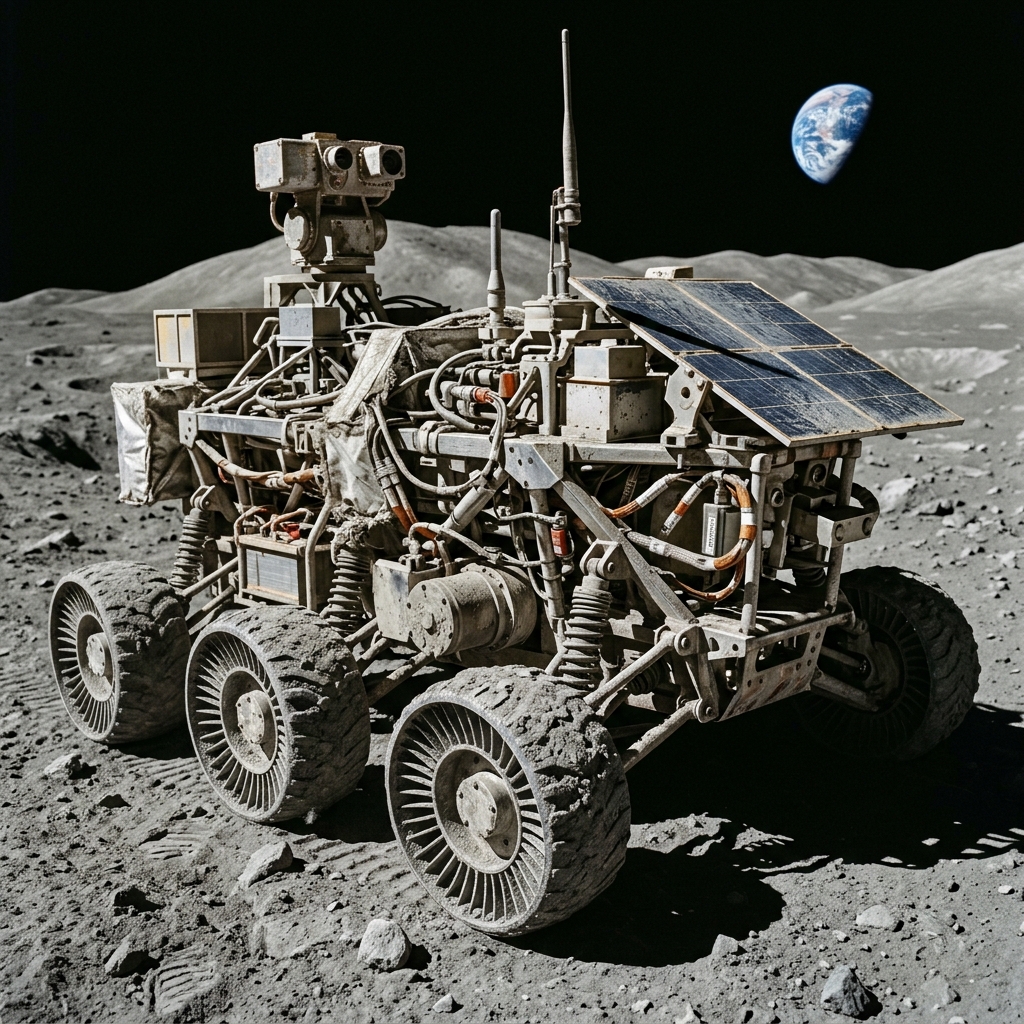
The Moon's south pole contains permanently shadowed craters harbouring water ice — the most strategically valuable resource in the cislunar economy. Reaching it, mapping it, and eventually extracting it requires rover systems that can operate autonomously in extreme thermal environments, rugged terrain, and complete communications latency — for weeks, without a single human intervention. Building those systems is harder than building the rocket that gets there.
Gaganorbit's rover systems programme develops autonomous ground and planetary rover platforms with three primary application areas: lunar surface exploration and resource mapping, Mars terrain navigation with scientific payload integration, and near-Earth asteroid surface anchoring and sampling. Our engineering approach draws deliberately from our satellite bus expertise — applying the same power system architecture, computing philosophy, and thermal design principles to rover platforms, creating genuine technology synergies across our product lines.
The same MPPT-based power management we are developing for GaganPOWER-1 is directly applicable to a rover's solar array regulation. The same radiation-tolerant computing architecture in GaganCOMPUTE-1 is the processing backbone of a rover's autonomous navigation stack. Building competency in one domain accelerates the other — this is a deliberate design choice, not a coincidence.
India's Chandrayaan-3 mission demonstrated that Indian systems can land on the Moon and deploy a functioning rover. Pragyan covered 100 metres of lunar surface and transmitted scientifically significant data before entering sleep mode. What Pragyan also revealed is the enormous opportunity in the next generation — longer-endurance rovers, higher-autonomy navigation, precision resource sampling capability.
In the near term, the rover technology developed by Gaganorbit will find immediate commercial applications in terrestrial environments — remote sensing for mining and geological survey, defence surveillance and perimeter security, and disaster response navigation in environments too dangerous for human entry. This terrestrial pathway is not a compromise. It is a deliberate funding strategy: rover systems that generate commercial revenue on Earth while building the engineering maturity needed for planetary deployment.
Execution Framework
Autonomous Navigation
SLAM, path planning, and obstacle avoidance for unstructured planetary terrain.
Radiation Tolerance
Drive electronics and chassis designed for high-radiation planetary regimes.
Regolith Sampling
Lunar regolith sampling and subsurface drilling mechanism design.
Thermal Endurance
Thermal design for extreme environments (lunar night: -183°C, day: +127°C).
Mission Power
RTG-compatible architecture and solar array MPPT for multi-week surface ops.
Terrestrial Application
Variants for defence surveillance, geological survey, and disaster response.
Payload Interfaces
Integration interfaces for scientific instruments and resource detection sensors.

Ready to Integrate?
Collaborate with our engineering team to integrate Gaganorbit architectures into your mission profile.