
Space Data Centres
Orbital edge-compute infrastructure for real-time telemetry and autonomous processing.
Initiate Technical BriefExecutive Briefing
Every minute, the Earth observation satellites orbiting 500 kilometres above your head are generating more data than their downlink capacity can transmit. The future of space computing is not on the ground. It is in orbit, where the data is generated, where the latency is zero, and where edge processing is a necessity.
Satellite constellations handle terabytes of Earth imagery daily. As these numbers compound through the 2030s, terrestrial data processing infrastructure will face a fundamental scalability constraint. The answer is orbital edge computing: satellites purpose-built for processing, storage, and routing of data. These platforms will sit in low Earth orbit, adjacent to observation and communications satellites, processing it before downlink. The result: dramatically reduced downlink requirements, faster insight delivery, and new categories of in-orbit AI applications.
This is not science fiction. The first orbital edge computing platforms are already being deployed globally. India's position in this market is compelling. ISRO's launch cadence provides access to LEO at a cost that makes orbital data infrastructure economically viable. And India's strategic interest in maintaining sovereign data processing capability — not routing defense satellite data through foreign ground stations — makes orbital data centres a national security priority.
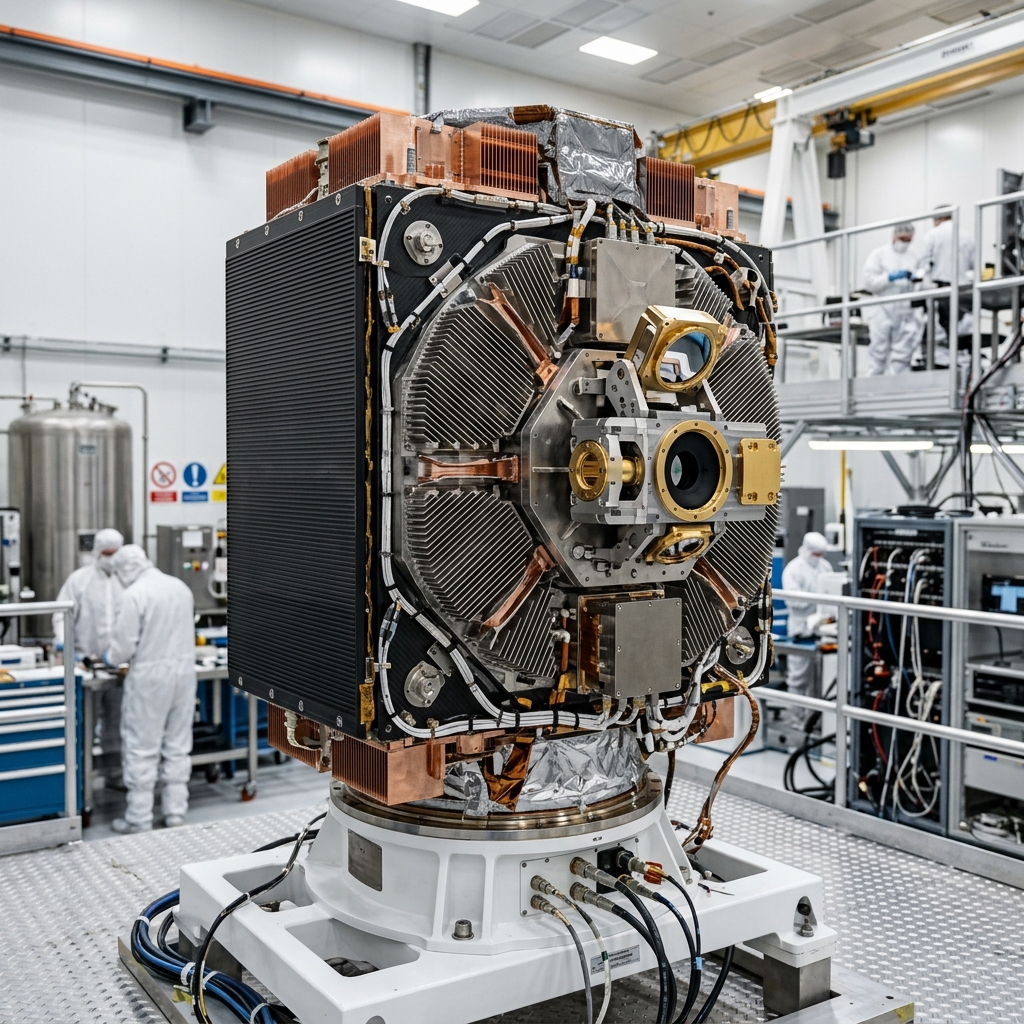
Gaganorbit is building the foundational expertise — power systems for high-draw computing payloads, thermal management for dense compute architectures in vacuum, radiation-hardened storage and processing systems — that forms the engineering basis of orbital data centre design. We are not yet deploying orbital data centres. We are building the team and the technology stack that will deploy them.
Execution Framework
Edge Architecture
Bus design optimised for compute density, power delivery, and thermal dissipation.
Hardened Storage
Radiation-hardened flash and DRAM storage qualified for LEO/MEO environments.
Optical Inter-links
Free-space optical (FSO) systems for intra-constellation relay at 10+ Gbps.
In-Orbit AI
Onboard neural processing units (NPUs) for real-time analysis and anomaly ID.
Thermal Management
Heat pipes and deployable radiators for high-TDP computing payloads.
High-Draw Power
Extended solar arrays and high-voltage distribution for sustained server load.

Ready to Integrate?
Collaborate with our engineering team to integrate Gaganorbit architectures into your mission profile.